

by Amin Safaeesirat, Saman Moghimi-Araghi (Physics Department, Sharif University of Technology)
Email me!
The presence of both critical behavior and oscillating patterns in brain dynamics is a very interesting issue. In this work, we have considered a model for a neuron population, where each neuron is modeled by an over-damped rotator. We have found that in the space of external parameters, there exist some regions that system shows synchronization. Interestingly, just at the transition point, the avalanche statistics show a power-law behavior. Also, in the case of small systems, the (partially) synchronization and power-law behavior can happen at the same time.

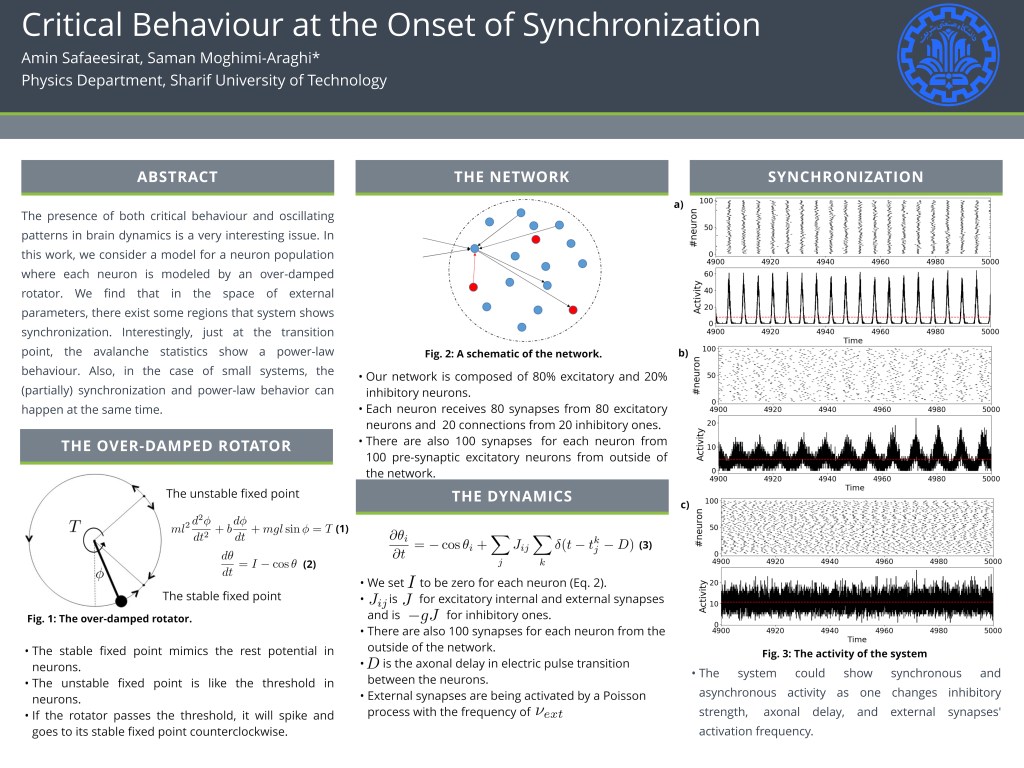
Criticality and oscillatory patterns of activity are two well-known behavior in neuronal systems. The presence of these two behaviour at the same time could be controversial. On the one hand, synchronization introduces a scale to the system; on the other hand, the system should be scale-free due to the criticality. Our main concern in this work is to show how they can happen together simultaneously. We have used the over-damped rotator as our single neuron model and put them on a random network consists of both inhibitory and excitatory neurons. Tuning inhibitory strength, axonal delay, and external stimulation, we observed synchronized and asynchronized activity in the system.

We have defined a suitable quantitative order parameter to identify synchrony in the network. Using the order parameter, we have found some synchronous areas in the system’s phase diagram. We have recognized that the synchrony results from the axonal delay and areas’ locations change as the value of axonal delay varies. We have plotted probability avalanche size as well as period distribution functions for the system. Interestingly, the distributions become power-law somewhere between synchronous and asynchronous regions closer to the asynchronous area.

We have changed the system’s size and found that the scale of power-law behavior increases with the system’s size. In addition, the critical point gets closer to asynchronous states as the system becomes bigger. We expect that the order parameter for an infinitely large system is zero (the hallmark of second-order transition). In other words, for large systems, the critical point occurs at the onset of synchronization. For further investigation of the system in terms of criticality, we have performed finite-size scaling analysis for our system and checked the self-consistency of calculated exponents. The exponents are close to experimental results.